What Is Contract Lighting?

Contract lighting means lighting fixtures made for professional projects: hotels, restaurants, spas, offices, retail. They are specified by an architect or an interior designer, ordered by the hundred rather than by the piece, and expected to survive a use that no domestic fixture ever sees.
One warning before going further, because the phrase is ambiguous in English. A search for contract lighting also returns results about lighting as a service, meaning an energy contract where a provider installs and maintains fixtures against a monthly fee. That is a financing arrangement. It has nothing to do with what follows. This page is about the fixture, not the invoice.
What contract grade actually means
The term is used loosely by sellers. In practice it covers four things that a domestic fixture rarely carries at once.
- Build for handling. A hotel bedside lamp is moved by housekeeping every day for ten years. Base weight, cable strain relief, switch mechanism and hardware connections are what fail first, long before the finish does.
- Reproducibility. A domestic piece is sold once. A contract piece is sold two hundred times, and the two hundredth must match the first one in finish, colour temperature and dimension. Variation that reads as artisanal on one piece reads as a defect across a corridor.
- Replaceability. Three years after opening, the property must be able to order eight more of the same reference. A maker who has moved on is a real operational problem, not a detail.
- Certification for the destination market. The subject of the next section, and the one that derails projects.
Certification is where projects break
Most decorative lighting for the European and American markets is manufactured in Asia to European electrical conventions. The mains socket used there is the E27. The United States uses the E26. The two screw into each other. That is exactly the trap.
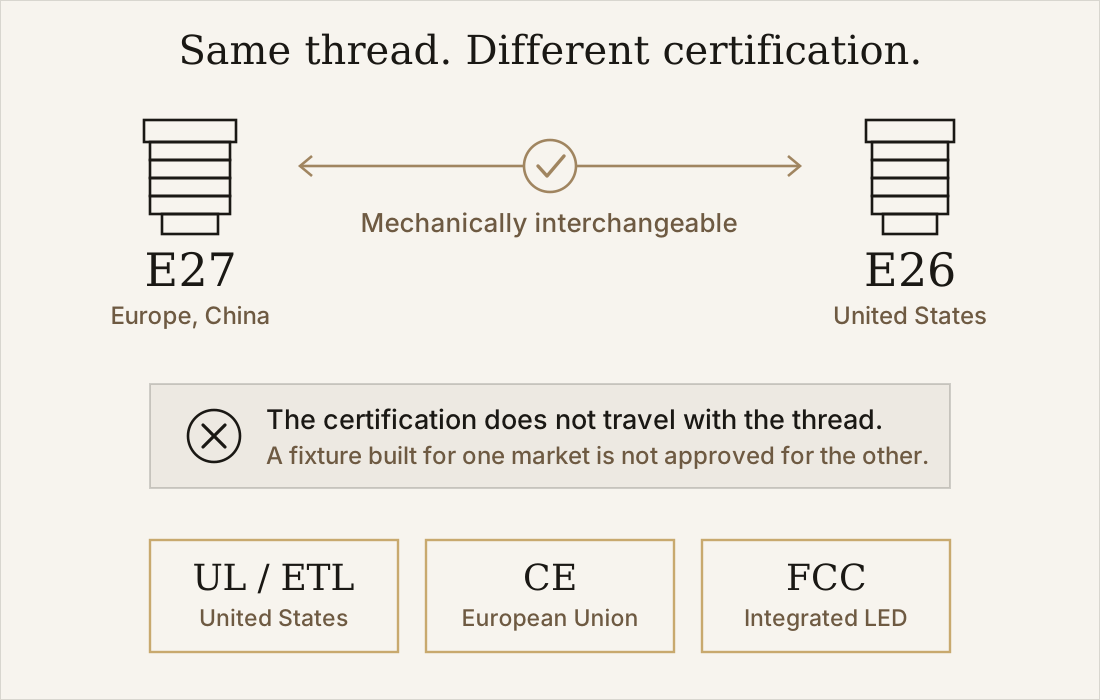
A fixture that physically accepts an American bulb is not an approved fixture in the United States. Approval is a separate act, carried by a mark: UL or ETL for the US and Canada, CE for the European Union, and FCC in addition when the LED is integrated into the fixture rather than replaceable.
The question to ask a supplier is not whether the product can be certified. It is who pays for the certification and who holds the certificate. In our own sourcing work we have met the pattern more than once: a maker offers certification only at the customer's request and at the customer's cost. That answer moves the entire expense and the entire liability onto the buyer, and it usually arrives after the price has been agreed.
Ask for the certificate number and the name of the body that issued it, before the deposit. A certificate that exists is a document you can read. A certificate that is promised is a line in an email.
What a contract catalogue really looks like
Anyone approaching this market for the first time expects a price list. That is not what arrives. We have gone through supplier quotation files running to more than a thousand six hundred product lines, and the pattern is consistent.
- A general catalogue is a specification catalogue, largely without prices. On one file we analysed, fewer than two hundred lines out of roughly nine hundred carried a price at all. This is not an oversight. It reflects a quote on demand model, where the price depends on quantity, finish and timing.
- Data quality is structurally uneven. Weight columns sitting under a price header, missing dimensions, absent weights. Any tool you build to read these files should correct only what is verifiable and flag the rest rather than guess.
- An empty reference means a variant of the line above. Read that convention wrong and your line count is meaningless.
- Commercial references are deliberately different from factory codes. That is sourcing protection on the seller's part, not a data error. Do not try to reconcile them.
The lead time and the freight nobody costs in
Custom pieces from workshop makers commonly run twelve to twenty weeks. On almost every hospitality fit out, decorative lighting sits on the critical path, which means the specification has to be settled before most other design decisions.
The second surprise is physical. A sculptural pendant does not ship like a lamp, it ships like furniture.
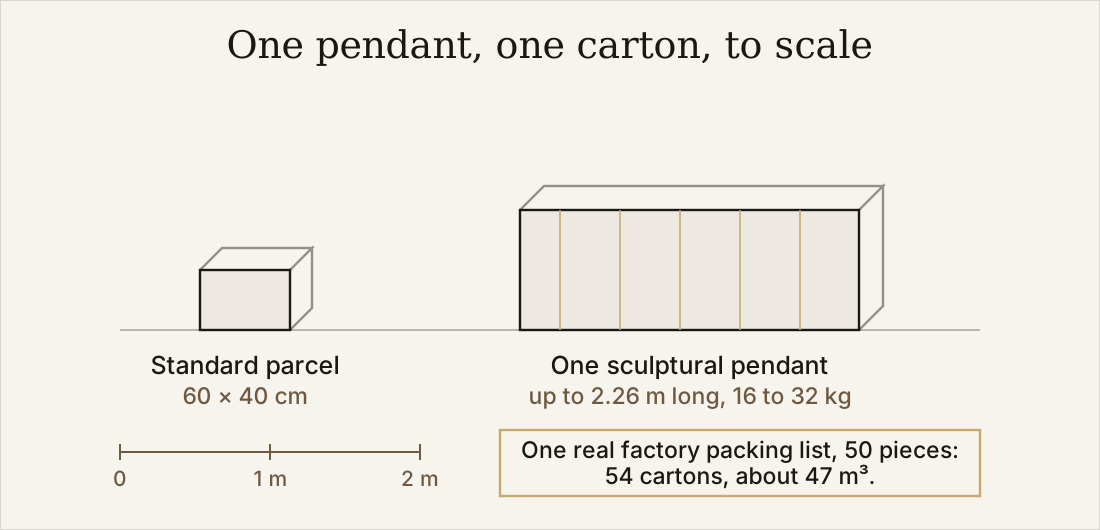
The figures above come from a real factory packing list we worked through, cross checked against the proforma for the same order. Fifty pieces filled fifty four cartons for roughly forty seven cubic metres, with individual cartons between 136 and 226 cm on the long side and 16 to 32 kg each.
What that means commercially: on very bulky, low density pieces, sea freight can cost more than the goods inside the carton. A quote given to you in ex works terms is not a budget. Ask for a real forwarder rate on your own volume before you present a figure to a client.
Commercial terms worth reading twice
These are conditions we have seen on real proformas in this trade. None of them is unusual. All of them are negotiable, and none of them is negotiable after you have paid.
- Payment in full at order. Common, and it means you carry the entire performance risk. A staged payment against a pre shipment inspection is the normal counter proposal.
- Offer valid seven days. Short validity is a real constraint when a client takes three weeks to approve a specification. Ask for the validity you actually need.
- Warranty phrased as resolution by negotiation. Read that literally: it is not a commitment to take anything back. If physical return matters to you, it has to be written as physical return.
Four documents to require before shipment, every time:
- real photographs of the finished product, not catalogue renders;
- the final specification sheet and the packaging specification;
- a video of the pieces being packed into their cartons;
- an invoice whose description matches the goods exactly.
When contract lighting is the wrong answer
A supplier's guide tells you when to buy. This one should also tell you when not to, so here it is.
- When the piece is architectural rather than decorative. Recessed downlights, track systems and emergency lighting belong to the electrical package and to a technical lighting manufacturer, not to a decorative maker.
- When the quantity is small and the certification is missing. Certifying a fixture for a run of twelve pieces rarely pays for itself. Specify something already approved for your market instead.
- When the opening date is inside the lead time. A twelve week piece ordered ten weeks out is not a lighting decision, it is a delay you have chosen to buy.
The specification that fails is almost never the one that chose the wrong shape. It is the one that chose the right shape and never asked for the certificate.
Next step
If you are specifying now, the brief builder turns this into a structured document in about two minutes, and it is free.
Open the lighting brief builder
Related reading: how to write a lighting brief and how to size a chandelier for high ceilings. To discuss a project, use the sourcing request form.