How to Make Two Lighting Quotes Comparable

You asked three makers for a price on the same twelve pendants. Three numbers came back and they are twenty percent apart. Before concluding anything about the makers, check that you received three prices for the same thing. Usually you did not.
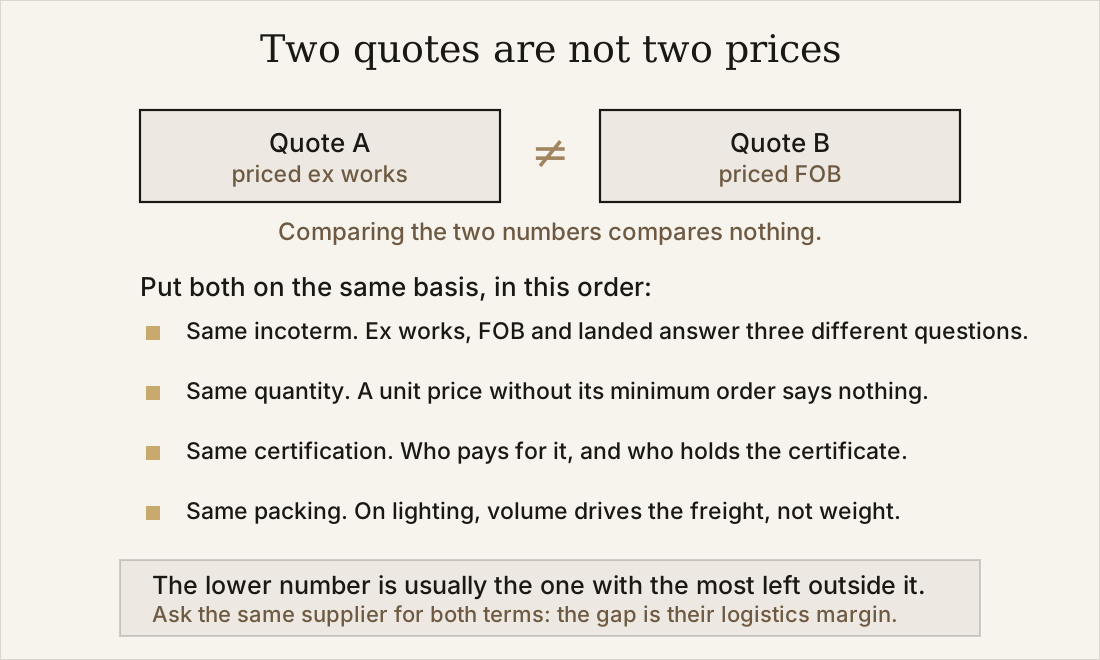
1. Same incoterm, or you are comparing nothing
A price at the factory door covers the goods and stops there. A price at the port of departure includes the inland leg and export clearance. A landed price includes sea freight, duties and delivery. These are three different questions, and the lowest number is usually the one with the most left outside it.
The useful move: ask the same maker for two terms on the same order. The gap between them is that maker's logistics margin, and it is the only way to see it.
2. Same quantity, because a unit price without its minimum says nothing
Setup, tooling and finishing costs are spread across the run. A unit price quoted at fifty pieces and one quoted at twelve are not the same product economically, even from the same workshop. Always ask for the price at your real quantity and at one step above it: the slope tells you where the setup cost sits, and sometimes buying twenty is cheaper in total than buying twelve.
3. Same certification scope
Two quotes can differ by exactly the cost of a certificate. Ask each maker, in writing, whether the price includes certification for your destination market, who pays for it and who holds it. A maker who certifies only on request, at your cost, is quoting a lower number for a smaller job. That is not dishonest, but it is not comparable either.
4. Same packing, and this is the lighting specific one
On most products you compare weight. On decorative lighting you compare volume, because the pieces are mostly air in a box. On a real factory packing list we worked through, fifty sculptural pendants filled fifty four cartons for roughly forty seven cubic metres, with cartons up to 226 cm on the long side. A maker who packs tighter, or who designs for flat packing and site assembly, can be materially cheaper delivered while quoting higher at the door.
Ask for the carton dimensions and the number of pieces per carton with the quote. If a maker cannot give them, the quote is not finished.
The reference trap
A practical warning for anyone trying to line up two catalogues in a spreadsheet, learned the hard way on files of more than a thousand six hundred product lines.
- Commercial references are deliberately different from factory codes. That is the seller protecting their sourcing, not a data error. You will not reconcile them, and trying wastes days.
- An empty reference cell means a variant of the line above, not a missing product. Read it wrong and your line count, and therefore your comparison, is meaningless.
- A general catalogue is a specification catalogue, largely without prices. On one file we analysed, fewer than two hundred lines out of roughly nine hundred carried a price. That is a quote on demand model, not an omission.
What to ask, in one message
Send the same six lines to every maker and the comparison writes itself:
- price at ex works and at FOB, same order;
- price at our quantity and at the next step up;
- whether certification for our market is included, and who holds the certificate;
- carton dimensions and pieces per carton;
- lead time from approved sample to ready for shipment;
- payment terms and what the warranty covers physically.
A maker who answers all six is already telling you they have done this before. For what sits behind those questions, see what contract lighting means.
Next step
The brief builder produces the document that makes those six questions answerable in one pass, rather than in six emails.
Open the lighting brief builder
Catalogue and packing observations are our own, from supplier quotation files and a factory packing list. To discuss a project, use the sourcing request form.